
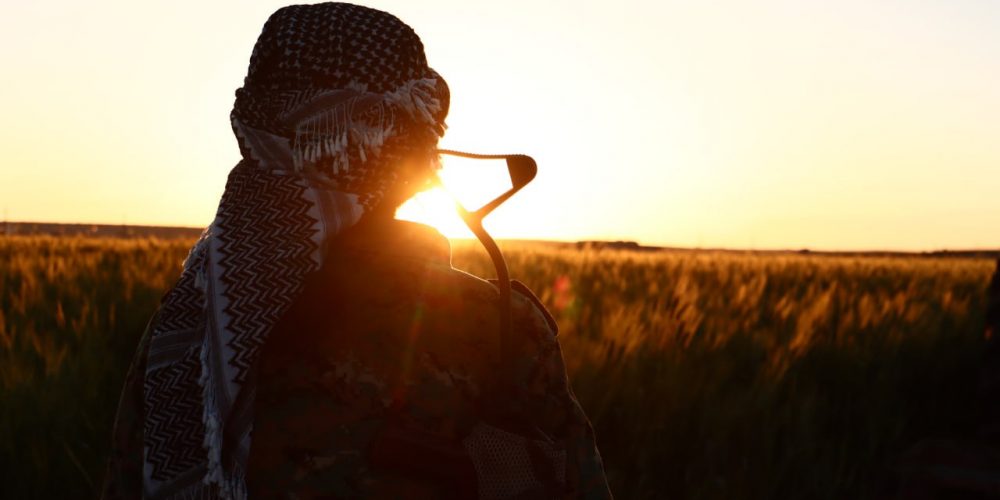
We are in the Middle of the third world war. No matter if you take a closer look to Europa, the Middle East, Asia or the African continent. Wars and armed conflicts are on the forefront. Wars, especially waged by states, are primarily driven by economic interests (oil reserves and other natural resources) and fighting for supremacy (e.g., proxy wars during the Cold War until today). Wars are sometimes justified on so-called humanitarian grounds, such as the defence of women’s or human rights, or as preventive strikes. Yet even here it is evident that those who suffer most from wars are ultimately women and children, while whole societies get destroyed. War brings no good to anyone, except profit for the military-industrial complex. Furthermore, historically speaking and up to the present day, war has been waged predominantly by men, as they have been at the head of kingdoms, empires, or states. Underlying this is a patriarchal mindset characterised by oppression, destruction and division, and the notion that one life is more valuable than another.
Wars and conflicts, however, have never gone unanswered. Women and women’s organizations are known, both historically and today, for playing a major role in peace processes and peace movements. One example is the International Conference of Socialist Women Against War, held in Bern in 1915 under the leadership of Clara Zetkin, which was directed against World War I.
The Peace Mothers in Turkey/Northern Kurdistan, the “Madres de la Paz” (Mothers of Peace) in Colombia, and the Women for Peace in East and West Germany in the 1980s are also examples of the role women play in the struggle for peace. Women also play a major role in peace processes among indigenous populations, such as the women of the Igbo culture in Nigeria, who can enforce peace, or the Council of Mothers of the Haudenosaunee (Iroquois Confederacy), who hold a veto over war and can also depose a leader should he fail to act in the interests of peace and society.
So, if it is primarily men who wage wars, and women who stand up for peace, how can a women’s army that also participates in war—such as the YPJ—be seen as a symbol of peace? Why should women become part of this murderous war system?
The war in Syria in early 2011, the war against ISIS and other jihadist forces, was not a chosen war by YPJ. Waging war was never the goal of the women of the YPJ. The goal, with which the democratic and, at that time, primarily Kurdish forces set out, was a third way: a way out of the crisis and the war. A path that neither sought a Syrian state under the Ba’ath Party
nor wished to surrender to the jihadist movements of Al-Qaeda, ISIS and others. A third way beyond a dictatorial state and jihadism: namely a diverse society that organizes itself based on the values of women’s liberation, ecology, and true democracy. Taking up arms was not an expression of a desire for war, but rather a necessity to defend precisely this path, this vision.
Not to fight in this case would have meant silence and submission to one of the other paths—a retreat. But silence and stillness must not be confused with peace. An example: A family is not peaceful simply because the wife remains silent in the face of her husband’s violence. And a family is not destroyed simply because the wife defends herself against this. It was already broken beforehand, and what appeared peaceful on the outside was in reality the woman’s submission and humiliation. And the same is true for peoples. A country is not at peace simply because there is no war. When a people rises up from humiliation, denial, and non-existence within this supposed peace, this is not a sign of war, but a sign of human dignity. And of course, in doing so, the weapon should always be the last choice, when all other democratic ways have failed. Protecting one’s own life and the lives of others in society—and this refers not only to physical existence but to a life lived with dignity—is self-defense. Just like every living being, whether it is a plant or an animal, it has its own means and ways of protecting and defending itself against attacks. It is something natural. And likewise, it is a natural right for humans and societies to defend themselves.
The YPJ was and remains an army of self-defense, not of aggression. The YPJ has never launched attacks on its own initiative. Its own existence, the existence of society, democracy, women’s liberation, and nature must be defended; that is why we speak of an army that stands for peace and democracy, not for destruction. And this is what makes YPJ unique compared to other armies, in which women may also take place as individuals, but where the army acts in the interests of the capitalist and patriarchal system. There may be women in other armies, but the mentality remains the same. Unlike other (state) armies, the YPJ does not carry out attacks on other territories. It is not about oppression, exploitation or gaining supremacy but about the mentality of self-defense. YPJ is and was always more than women taking up arms. It was women organizing themselves and cultivating the culture of self-defense in all its diverse ways.
The goal of integrating the YPJ into the Syrian army is to spread precisely these values throughout Syria and to ensure that true peace and a dignified life is possible.
And that is why it is not a contradiction to be against war and in favor of YPJ, and the slogans “No more war” and “We are all YPJ” are therefore not opposites but are intertwined.